Sunday, June 14, 2015

# 56 Paul Butterfield' s Better Days

    Most successful artists will confide that reaching the top seems like the easy part; it's holding on your place that is the greater challenge.  As Van Morrison laments in Back on Top,... You'll find out when you get to the top/ That there's nowhere to go.  This of course is not true, once you get to the top, you can quickly slide back to the bottom, often in less time than it takes you to reach your goal.

   Butterfield is similar to most of the stars of '60's Blues/Rock, he makes his share of the sacrifices to reach the top.  Between 1964 and 1972,  he travels a long precarious road from university drop out headlining at the tiny club Big John's on Chicago's Near North Side, to the position of the most successful blues singer of his generation.  He is actually a major contributor to this new trend, and consequently, there isn't a shortage of  young musicians willing, and able to nudge him from his throne.

   Looking back at his accomplishments with The Paul Butterfield Blues Band, and then the Butterfield Blues Band, he knows his contributions are recorded in the history books, and for that he has the respect of his industry peers. In addition, the rewards of his success have bought him all the material trappings of the American Dream.  He has a family, a comfortable house on several acres off Route 212, replete with horses and dogs. At 30 years of age, Paul Butterfield has everything that an average man will work his whole life to achieve. 

    He earns those accolades and rewards by recording seven critically acclaimed albums, living a grinding cycle of preparation, rehearsals, recording, incessant touring, promotional interviews, replacing band members, and at times, struggling to maintain a creative freshness for his growing fanbase.  

    But by the end 1971, approaching 30 years of age, he finds himself without an established band, the perks and security of his multinational label Elektra are gone, and the musical tastes of the record buying public is rapidly changing. All of this serves as the backdrop for his next album, Better Days. For Butterfield, his biggest challenge will be to capitalize on his past successes, and yet produce a new product which will prove to the industry, as well as fans, that he is still a creative force. As American composer/lyricist Irving Berlin noted at the height of his own success: The toughest thing about being a success is that you have to keep on being a success.

    However, he is still driven to create and as always quite resourceful. He has assembled a new band of highly skilled musicians, and is working with Geoff Muldaur to prepare a set list of material which will distance him from his past, and yet advertize his ability to adapt to new directions. After several obstacles, by late '72, his band, Better Days, is in Bearsville Studios recording the first album of his renewed career.

   When you hold the first Paul Butterfield's Better Days album in your hands, you can sense that something has changed.  Firstly, the packaging is different. Gone are the photos of his band with defiant stance, or a psychedelic collage; instead we have a simple, yet imposing photograph of an artifact. When you open up the cover and hold the whole thing in front you see a beautiful 1923 Hohner Trumpet Call replete with solid brass cover plates which boast intricate high-relief designs of cherubs, and trumpets; it isn't just another harmonica, but a work of art. It is definitely the quality a fan would expect an artist of Butterfield's caliber would own. (This is Butterfield's harp, but he doesn't use it on the album.) 

   Then, you notice, there is no photo of the band, nor is there the familiar logo the Butterfield Blues Band which is owned by his former label. There is only a list of the member's names, printed in the same moderate font size, indicating it is not an artist and his band, but rather, a band of artists working together. When you open up the cover, it is both simple and dramatic with solid white song titles over a black background, all of which jumps right out at you. (photographed by his wife Katherine)

   When you reach in to retrieve the album, there is another surprise. It's a 12" by 24" pull out with photos of the band relaxing, and their brief biographies. Then you flip it over and it's like a personal gift from Butterfield to his fans, he has given you a huge poster of his antique harmonica. The whole package is simple, attractive, and different. (This poster will be framed or laminated, and proudly displayed on walls of apartment living rooms, and bedrooms everywhere! It even appears on the cover of Bobby Charles' album Wish You Were Here Right Now.)

    Then there is the music, it's noticeably different too. Even the title of the first track is changed to reflect a new approach to a song Butterfield covers back in edgier days. He is calling it New Walkin' Blues now, and it sounds like nothing any other bluesman has ever done with the song. He is using the softer sounds of an electric piano leading the listener into a medium tempo groove, Robert Johnson would be impressed.


   There is none of the testosterone driven music of the Paul Butterfield Blues Band or the Butterfield Blues Band on Better Days. This is a different band, with a unique vision of old and new music.  It's a calculated mix of rural blues next to more cosmopolitan urban blues of Percy Mayfield,  then traditional folk, gospel, and New Orleans R. & B.. As Geoff Muldaur says, We're the only band around that's playing rooted American music. In 1972 this Roots music is a fairly new sub-genre of popular music, and while Better Days may not be the first band to enter into the new genre, they are definitely pioneers in the music.

    However, many of the Blues/Rock stars of the '60's are starting to plateau, and the album doesn't sell that well in the mainstream market. The critics are generally kind, but even the infectious groove of New Walkin' Blues, and the cathartic Please Send Me Someone to Love as the single, will not help to push the album beyond #145 on the charts.

    The cause of the mediocre sales is difficult to reveal. It could be as simple as the fact the album is released in January of 1973, missing the important Christmas shopping market, or it's competing with The Allman Brothers Ramblin' Man, Jim Croce's Bad, Bad Leroy Brown or Edgar Winter's Frankenstein.  One critic concludes it is because there are three main vocalist in the band, taking the focus away Butterfield. Some even think it's because none of principal singers project the kind of sex appeal that a Greg Allman, Mick Jagger or Rod Stewart do. 

    America's premier popular culture newspaper Rolling Stone thinks the problem is more psychological,  Unlike Van Morrison, for instance, Butterfield always conceived of the blues as a tradition, not a sensibility. Even after he disbanded the Blues Band and formed Better Days, he never projected himself, never conveyed a sense of who he was or what he wanted to say. While both albums boast a formal imagination, they lack a personal one.... . But this diagnosis lacks insight and only serves to expose someone who is only moderately familiar with Roots Music.
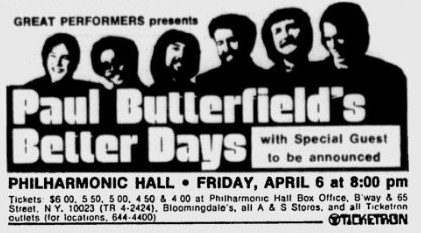

     While it is true that Butterfield never projects the sex appeal of say a Mick Jagger or Rod Stewart, it doesn't mean he does not project himself through his music. No one accuses Bob Dylan of the same artistic crime. One only needs to look at the set list of Better Days to glimpse inside the mind, and life of Paul Butterfield.

    Most pop song lyrics directed at the important 18 to 24 market are intentionally ambiguous (many songwriters, like Bob Dylan, Van Morrison, and Mick Jagger write down several song ideas, and then set about the task of piecing them together in an effort to create a theme.) This process works to the benefit of both the writer, and the listener because the listener can create their own meaning from the lyrics. This is why so many songwriters do not want to provide specifics on the meaning of their lyrics, they risk limiting their meaning, and potentially losing fans in the process. However, this is usually not a problem with most blues, which is, with the exception of the double-entendre, self explanatory.

    Superficially, a critic can argue that the set list of Better Days is too rich in the very adult emotions of brooding guilt, regret, self-awareness, self doubt, depression, reconciliation as well as contentment and joy. If you use these songs to sketch a personal profile of Paul Butterfield, it is of a 30 year old man who is troubled, lonely, guilty of adultery, buried in his own blues; a man who is pulling off of the road to success, realizing that he can never rule it. There does seem to be some truth to this interpretation, as it is around this period that Butterfield's personal, and professional life start to spiral downward, but it is unlikely that this is the intention of the song choice. Contrary to what many people believe, songs in general, and Blues specifically, are intended to act as a catharsis for the listener, not an instigator of negative emotion. So, does Paul Butterfield project himself through his music? The answer to the question is the same as for any artist, yes, but it is a subjective yes.  

   Overall, the general reception of Butterfield's new album Better Days is positive. There are people who call the album wooden, too slow, sleepy, music for the wine and reds set, but others refer to it as passionate, exciting. Billboard says, Most assuredly the blues with which Butterfield has become associated with over the years, the arrangement and vocals are more commercially oriented than anything he has ever done. The Band is extremely tight, and Butterfield's vocals are smooth while still conveying the blues. The music on Better Days is definitely a departure for Butterfield, and his fans. The more reflective, relaxed, rural mood, is both a reflection of his personal life, and the tone of the maturing Woodstock generation.

   Historically, there are some other things about the music of this album which are unique to American popular music in the 70's, and unique to Butterfield's music. Better Days can be seen as one of the first bands to actively tour playing  Roots Music, or as we call it today, Americana. Also, the musicianship is timeless, as one critic raves that Amos Garrett's guitar solo on Please Send Me Someone to Love, .... belongs on the top ten list of of top guitar solos of ALL time.  Gone is the prominent role of the horn section, as is his role as the lead singer. Butterfield only sings lead on three of the nine songs. This is also the first time he is using string arrangements, (Done A Lot of Wrong Things), and for the first time he, along with Geoff Muldaur, is the producer.

     There is another little known fact about this particular Better Days album. In 1973, it is one of those albums which makes its way into the record collections of people who are not  Blues fans. It can be found mixed in with albums by Yes, Pink Floyd, or Alice Cooper. It may seem like a minor success, but it is a success none the less. In the end, perhaps Paul Butterfield's Better Days first album's greatest accomplishment is that it's music still sounds fresh almost 42 years after its release.

   The true measure of the success of an artist's music can never be completely known at the time of creation, it needs time to grow an audience. The answer to the question is often discovered decades after the fact when people are still enjoying it.  In the case of Paul Butterfield's Better Days, the answer is a resounding yes. People still buy and enjoy the band's music, it is often cited as one of forgotten gems of the '70's, and critics still rave about the musicianship of the band; these must be some of the greatest compliments an artist can receive.

Paul Butterfield's Better Days, Better Days , Bearsville BR-2119, January 1973
New Walkin’ Blues, Please Send Me Someone To Love, Broke My Baby’s Heart, Done A Lot Of  Wrong Things, Baby Please Don’t Go, Buried Alive In The Blues, Rule The Road, Nobody’s Fault But Mine, Highway 28.

Paul Butterfield, vocal, harp, (electric piano on  New Walkin’ Blues, Done A Lot Of Wrong Things),
Ronnie Barron, organ and piano, (vocal on Broke My Baby’s Heart),
Amos Garrett, guitar, slide guitar, acoustic guitar, bass, vocal on Rule The Road, Geoff Muldaur, slide guitar, piano, electric piano, acoustic guitar, guitar, vibes, (vocal on Please Send Me Someone To Love, Done A Lot Of Wrong Things, Baby Please Don’t Go, Buried Alive In The Blues, Rule The Road, Nobody’s Fault But Mine, Highway 28, Arranged Strings on Done A Lot Of Wrong Things,
Christopher Parker, drums,
Billy Rich, bass,
Howard Johnson, baritone sax, horn arranger on Please Send Me Someone To Love, and Broke My Baby’s Heart,
Peter Ecklund, trumpet,
Sam Burtis, trombone,
Gene Dinwiddie, tenor sax,
David Sanborn, alto sax,
Stan Shafran, trumpet,
J.D. Parran, tenor sax,
Gary Brocks, trombone,
Background vocals, Paul Butterfield, Geoff Muldaur, Maria Muldaur, Amos Garrett, Bobby Charles, Dennis Whitted, Ronnie Barron.

Produced by: Paul Butterfield and Geoff Muldaur, Engineered by: Nick Jameson, Recorded and mixed at Bearsville Studios in Bearsville, New York,
Black and white photography by: Katherine Butterfield,

Cover Design by: Milton Gaser, Push Pin Studios.


Wednesday, June 3, 2015

#55 Paul Butterfield is Building a Better Band

    A bandleader's job is similar to most other leadership positions because it is a single person charged with the responsibility of leading a group toward a goal. It has always been a coveted position in the competitive, and sometimes lucrative music industry. However, the fact is, not everyone has the leadership acumen to motivate the unique talents of artists toward producing a quality product. Great bandleaders must be bold, assertive, risk takers, and possess enough social intelligence to analyze situations, and then take an appropriate course of action.  In the words of  General Dwight Eisenhower, Leadership is the art of getting someone else to do something you want done because he wants to do it. 

    The other  attribute of  great leaders is that they are most often not born, but rather are created through on-the-job training.  For example, as the leader of T. P. B. B. B., Butterfield is a very autocratic bandleader, but over time, evolves through a few leadership styles to arrive at the more democratic approach he uses when working with his band Better Days. Much of the band's music, live performance, and recognition can be directly attributed to his egalitarian approach his group of musicians. It is this overlooked skill that makes him one of the most underrated bandleaders of the twentieth century, and definitely the best of his generation.


    However, there are critics who argue that he is not deserving of the accolade, and will quickly sight the facts that in 1964, he is resistant to the idea of hiring his generation's first guitar hero, Mike Bloomfield, and then he also needs too much persuasion to record one the anthems of the 60's,  Born In Chicago. However, these critics neglect to mention that in spite of his initial reluctance to accept advice, in the end he does listen, and then acts on the wisdom of the trusted people surrounding him.

    Another criticism leveled at Butterfield the bandleader is when he seems to hand over the reins of creative power to Gene Dinwiddie during the final years of his massive horn band the Butterfield Blues Band, but that too lacks credibility because it neglects to acknowledge that Butterfield has a unique ability to recognize an individual's strengths, and then use those strengths to help him achieve a final goal. As David Sanborn notes, Gene was the father figure to us all, ten years older, who had been around in Chicago, and knew the bebop vocabulary. He was such an accomplished player, the de facto music director, and just a huge inspiration to us all. He was the person everyone deferred to. He pulled the charts together, and directed the harmonics of the band...  Butterfield does what all other good leaders do, he surrounds himself with strong talent, and then utilizes it to achieve his goals. (Remember, he does the same thing with Mark Naftalin as an arranger.) This is another attribute of skilled leaders, delegation of tasks to the most capable.  

    In addition, David Sanborn says,  Paul really didn't read music that well. And by 1970, the band was playing some very involved charts and wonderful arrangements.  When you consider Butterfield is a three chord, twelve bar blues singer with a diatonic harmonica standing in front of  a band of sophisticated musicians who are playing complex chord changes over intricate rhythmic patterns, it is a testament to his ability to adapt to more complex expectations.

    One of the more challenging tasks of touring band is when the group is out on the road, and performing a steady stream of exhausting one night stands. It is up to the leader to keep the musicians focused, and momentum of creative energy going. According to long time Butterfield fan, and frequent witness to Butterfield's back-stage demeanor, Blues singer, Robert Bedard remembers, Butterfield always encouraged his soloists to play their asses off. I also remember him backstage, and once in their hotel rooms in Syracuse inspiring, and urging everyone to get 'INSIDE the song, and stay there to get the real feel of the tunes. As any leader will tell you, this is no small feat! In spite of the fact that he too must be feeling the road wear, he pushes himself to set the standard for everyone to follow.

    Butterfield is also a resilient leader as he shows when his big horn band the Butterfield Blues Band unexpectedly dissolves in 1971. He wastes little time assembling another group of talented musicians to form another band, the first version of Better Days. This time he has the benefit of being off the road, living in the artist community of Woodstock, and has direct access to some of a industry's most skilled artists.

   Paul Butterfield's Better Days is really a product of social meetings, jam sessions, and brainstorming sessions with several Woodstock luminaries, but most notably the husband and wife team, Geoff and Maria Muldaur. It is with this duo that he moulds the vision of a music which is a clear departure from anything his previous bands have created.

    Together with the Muldaurs, Amos Garrett, Chris Parker, Merle Saunders and John Kahn they rehearse, tour in the late spring through the summer of '72, and then minus, Garrett, and Geoff Muldaur, they record the soundtrack to iconic 1970's counter culture film  Steelyard Blues.with Mike Bloomfield and Nick Gravenites. (see blog #53) (The film doesn't do well at the box office, but is notable for the reprising the Fonda-Sutherland pairing. It is still considered an iconic 70's movie, and the soundtrack still holds up very well.)

    As a unforeseen test to Butterfield's resilience, organist, Merle Saunders, and bassist John Kahn leave the band at the end of the tour to return home to San Francisco. In addition, Maria Muldaur is preparing to leave to begin her solo career. The frustration for Butterfield must be draining as it means the search, and training for new talent must begin again. However, true this resilience, he returns to Woodstock, and begins the rebuilding  process.


    Consider this fact, in 1972, Rock Music is the most popular music on the planet, so there are literally thousands of musicians trying to break into the lucrative industry. Most will assume that the task of filling the keyboard, and bass positions will be simple, but it isn't. New musicians of Butterfield's caliber need to have specific skill sets. They need to be musically versatile, proficient on their instrument, open to new ideas, willing to do incessant rehearsing, and grueling tours in front of large audiences, but as important, they must fit into the social structure of the band.

    Auditioning new band members is time consuming, and often frustrating, so asking people in the business for referrals is a common practice that Butterfield uses often. He loves the Hammond B3 sound made popular by Jimmy Smith, this is one of the appeals of Merle Saunders sound, but with Saunders gone, the search for an appropriate replacement is a challenge. As is turns out, former Albert Grossman partner Bennett Glotzner, has been telling New Orleans pianist/singer Ronnie Barron, to get in touch with Butterfield since 1968, but circumstances never lead the two into the same room.

    In the 40's, Barron grows up in Algiers, Louisiana, but by the 50's he is living and working as a musician in New Orleans. As an example of resourcefulness of this young and ambitious talent, he concocts the idea to maintain steady employment by creating a fictional character called Reverend Ether. The stage gimmick serves him well, attracting the attention of tourists, bar owners, and eventually the interest of Atlantic Records owners Ahmet Ertegun and Jerry Wexler in New York City. When they hear of Barron, they fly to the Crescent city with the intention of signing him. Their problem is that Barron has bigger ambitions, he rejects Atlantic's offer, and packs up for a chance at stardom in L.A.. When he leaves New Orleans, he leaves his character Reverend Ether behind, but the tourist attraction gimmick is not forgotten. Another local piano play Mac Rebennack adopts the stage persona, changing the Reverend's name to Dr. John.

    In L.A., Barron secures a job as keyboardist, songwriter, and session leader with the young pop duo Sonny and Cher. However, Atlantic Records is persistent, and while Barron is enjoying his new success in the L.A. pop music scene Ahmet Ertegun shows up, and finally convinces him to sign up with a Pop, R. & B., Soul band called The Prime Ministers. He records several singles with the band, but after only moderate success becomes disillusioned with the whole star process, and so, leaves to begin a solo career by playing local clubs at night writing songs during the day. It isn't until he meets up with his former colleague Mac Rebennack, now known as Dr. John, that new opportunities are presented to him. It is Dr. John who will lead Ronnie Barron to Better Days.

    Rebennack brings Butterfield's manager Albert Grossman out to hear Barron play at a local club with the intention of introducing his friend to one of the most influential impresarios in the music industry.  Just like Atlantic Records people, Grossman is impressed with Barron, the next day he calls him up, and offers him a job. According to Barron, Grossman says, I tell you what. I'd like for you to come and look at this thing I've got with Paul Butterfield. Can you fly to Woodstock tomorrow That was too soon, but I was there on Saturday. In 1972, Paul Butterfield is almost a household name in America so working with him will be, at its very least, a wise career move.


    However, when he arrives in Woodstock, Barron he discovers it is both physically and spiritually a long way from New Orleans, and even more distant from L.A.. He finds the sleepy artist community is so silent, with harsh weather, he remembers,  It was remote, cold and creepy. To make matters more stressful, Grossman has someone whisk him down dark dirt roads to his villa for what is suppose to be a short social meeting. Then he introduces him to Butterfield, who is can be unfriendly toward of outsiders, and he has his band with him. I didn't like Geoff at first, says Barron. He was telling me what style of piano I was playing each time. Then Bobby Charles showed up. He was friends with all of those guys and living up there. I'd had all of his records on Chess when I was a kid and knew all of the songs, but I'd never met him. We didn't like each other much at first either. And Paul came up and gave me some shit. I just picked him up over my head, and that shocked everybody there. I'm a street dude and don't take that stuff. I was going to throw him down, but just put him back down instead. Butterfield is known to be resistant to change, and suspicious of people who are not within the confines of his professional sphere, but he wisely trusts Grossman's intuition, and of course Barron, is a perfect match for his new band's sound. It solves a problem for everyone associated with the new band, leaving only one more problem, a bass player.  

    Butterfield hires a few notable bass players over the course of career, Jerome Arnold, Bugsy Maugh and of course Rod Hicks are all diverse artists in their own right. However, filling the bass position in Better Days is proving difficult, and what he doesn't know is that a good choice is right in front of him. The perfect fit is Billy Rich, and not just because he comes with an impressive resume.  He is familiar playing country, Jazz or Funk, and as comfortable in the studio as he is on stage in front of a larger audiences.

    Only two months out of high school, Omaha, Nebraska native Billy Rich is on a 1968 tour in San Francisco with local band The Whispers when his brother Herbie, (founding member of The Electric Flag), refers him one of Rock's premier rock drummers, Buddy Miles. Miles (also a founding member of The Electric Flag) is currently building a solo career on that reputation. So, Rich joins Miles' Rock/Funk band The Buddy Miles Express, and the band's first major gig is at L.A.'s famous Whiskey A Go-Go. As a favor to Miles, and good promotional strategy, the '60's newest guitar hero, Jimi Hendrix joins the band on stage. Later that year The Buddy Miles Express will release its first album Electric Church (partially produced by Hendrix.), and include the highlight of the album 69 Freedom Special, a Rich composition. When the B.M. Express travels to London, England as an opening act for Hendrix's Royal Albert Hall gig, the guitarist asks Rich to play bass on his upcoming live album Band of Gypsys, but he has to decline because of his own commitments. In retrospect it is a missed opportunity, but is countered when he tours, and records the album Devotion with British Jazz/Rock fusion guitarist John McLaughlin.

    After working with McLaughlin, Rich gets a job with African-American Blues singer Taj Mahal. Mahal is in Woodstock working on his 1971 live album, The Real Thing.  It is while working with Mahal that he meets Butterfield,  I had been working with Taj, and we were living in Woodstock for a few months working on a double album, says Rich, that's where I first met Butterfield and Amos, and I knew Maria. We'd get together and jam at the Joyous Lake. But I left there and moved back to Denver.

    Rich's participation in Better Days is almost serendipitous in that he is only available to join the band because his current boss takes long vacations. As he recalls,  Taj Mahal takes vacations that last for a few months you know, so during one of those times Butter's manager, Albert Grossman, called me to see if I would come to Woodstock to record an album with the new Better Days Band. I said shit yeah! And I was back in Woodstock, N.Y.  The band, now officially known as Better Days, is in the studio, working on their song Highway 28 when Rich joins. He will become an important contributor to band's music, in the studio, out on tour, and the choice to have him in the band is welcomed by everyone.

    I knew Billy only by reputation, Chris Parker remembers,  from his gigs with Taj Mahal and as one of the two great bass players from Omaha -- Bugsy Maugh and Billy Rich. Geoff Muldaur too is happy with the addition of Rich, I'd never met Billy, ..... and he did an overdub standing in the control room. And on went this fucking bass part -- we go back and listen to it. We just couldn't believe it. And we looked at each other and said, 'Now we're there. Let's go.'

     I don't know if anyone thought it was going to work, Rich adds. I think Paul and Geoff and Ronnie knew what they wanted to do, but it just came together. Once we got into the studio and started working stuff out it really started to work well. The band was kind of like a democracy -- everyone wanted to be happy with what we were doing to make it work. Everyone had a lot of input. Billy Rich's sound will prove to be an important addition to the band's music over its two album lifespan.

    Bands are easy to assemble, and there is never a shortage of musicians to play in them groups, but building an excellent band requires, talent, vision and leadership. Listening to Paul Butterfield's Better Days over forty years after their birth, it is easy to understand why their music still sounds fresh. Each member has a a unique background of knowledge and style, from Geoff Muldaur's encyclopedic knowledge of music to Amos Garrett's unique string bending technique to Ronnie Barron's vocal range and Chris Parker's use of the snare drum. So much of all this great music is a result of artistic chemistry, and Butterfield's creative vision and leadership skills. It is what makes Better Days, pioneers in Americana, one of the most overlooked bands of the 1970's.


Sunday, September 7, 2014

# 54 Bobby Charles & Paul Butterfield


   Excellent songwriters are always in demand as a sub trade within the music industry. A singer may be a great interpreter of song, but a terrible songwriter, very few are good at both. History shows that most of the great singers from every generation use songwriters to create material for their own repertoire. Elvis, Sinatra, Muddy Waters, and Little Walter are only a few pre-sixties examples. 

   However, when Bob Dylan arrives on the mainstream pop scene in the early '60's, the role of the songwriter changes forever. Suddenly, the songwriters are center stage, and after Dylan, audiences expect their favourite singer to also perform songs their own material. 

    This new expectation is a very important development for popular music in the 60's. While it comes with new pressures for artists it also provides financial rewards for artists who are destined for brief careers as performers. The royalties generated from the recording of successful songs can, and often do, act as a pension plan for musicians. For example, one successful pop song can provide enough income for an artist to retire early from the grind of life on the road, and live a relatively comfortable lifestyle for their remaining  years.  

   Butterfield is a songwriter, but he isn't prolific, and none of his songs seem to capture the imagination of his audience, so he is a good candidate for a outside help. This is where his meeting of Bobby Charles proves to be so fortuitous. 

   Charles is born Robert Charles Guidry, grows up as a Cajun in Abbeville, Louisiana during the 40's. (Most of the Louisiana Cajuns are of French descent. During the 16 and 17 th century they settle in the Canadian maritime region, and live peaceful lives as Acadians. However, when the British take over the area in the 1700's they demand that the Acadians submit to their rule. When the Acadians refuse, they are executed or banished from Canada. This expulsion is an early example of ethnic cleansing in North American.The Band's performance of Robbie Robertson's song Acadian Driftwood is based on this experience) While the Acadians resettled in several different locations,  Louisiana is an important one. It is in this state that the word Acadian evolves into Cajun, their new culture flourishes. It is a brutal history of a people, and their culture, but one which gives birth to the artistry of Bobby Charles.

   So, as a Cajun, Charles grows listening to the music of his environment, but everything changes for him when, at 15, he hears Fats Domino for the first time. Years later he will recall that the experience changed my life forever. During the '50', he starts to write songs which are a combination of Cajun
and country music, the local industry even labels his work Swamp Pop. It is while working on his early career that he writes, and records songs like See You Later Alligator, Walkin' to New Orleans, Ain't Got No Home and But I Do, but unfortunately, none of his own recordings resonate with the mainstream audience. 

   However, in '56, Bill Haley and His Comets do have a hit with See You Later Alligator, and Charles' career as a songwriter is established. (Fat Domino will have success with another Charles song, Walkin' to New Orleans in '60, and then in '61, Clarence Frogman Henry will chart with the Charles composition But I Do).

   While Charles' success as a songwriter is growing by the late '50's, his career as a performer is not keeping stride, and so he leaves Louisiana to try his luck in L.A.. It is while in Los Angeles that a local record store owner hears his version of See You Later Alligator, and is so impressed with the young Cajun's work he contacts his friend Leonard Chess of Chess Records. The Chess Brothers  audition Charles over the phone, and immediately present him with a recording contract offer. However, after hearing Charles' vocal style; the Chess Brothers assume he is black, and are confounded when they finally meet the Cajun in the flesh. So, in an effort to repackage his public profile, the Chess Brothers decide to change his name from Robert Charles Guidry to Bobby Charles. Unfortunately, this does not help his career, his vocal interpretations do not resonate with the mainstream audience and so, he is released from contract by '57. He is disappointed, but regroups, and briefly records with the Imperial label, but that too ends in failure. The frustration leads Charles to retreat from the industry, and seek out other means of employment. 

   By 1972, Bobby Charles is living in New Mexico when he decides to move to the small town of Jeffersonville, New York. He isn't in their long before he decides that he doesn't like the vibes, and randomly chooses to move to Woodstock, New York. He is out of touch with the music business for a few years now, so according to him, he knows nothing about the Woodstock music scene. He isn't even aware that the Woodstock Music festival has made history. Charles also doesn't know that his move to Woodstock will change his life forever. 

   So, when he starts house hunting in Woodstock, he hires a real estate agent, and specifically instructs him to not show me any houses with the people living there because I don't want to take anyone's roof. However, the agent takes him to a house being occupied by Norman Smart 3rd, Jim Colgrove, and Paul Butterfield. (Charles, claims Butterfield is living in the back of the house.) He feels uncomfortable at first, but the mood changes when he sees the instruments set up in the house. The chance meeting sparks a conversation between the four musicians, and marks the beginning of a prosperous relationship for Charles, and Butterfield. 


  It is Butterfield who introduces Charles to industry giant Albert Grossman, and sets a new course for the songwriter. According to Charles, they all met at Grossman's restaurant, and then continued the evening at his Bearsville home. At the house party, Butterfield and Maria Muldaur are there to witness Grossman's first impressions, and the birth of Charles revived career. 


   The the new business relationship between Grossman, and Charles will prove to be significant for several singers in the 70's, but it is Butterfield's new band that reaps the initial rewards of the his talent. Charles will become an unofficial member of Better Days, and is often, according to Charles, inaccurately credited with giving them their name Better Days. He thinks that Butterfield already has the name, but concedes that it could come from a toast that he frequently uses, There ain't no love, where there ain't no wine, Better Days are coming. 

       Regardless of the speculation, Charles will either collaborate, or pen several songs for Butterfield's
new band. He writes Done A Lot of Wrong Things for the first Better Days album, and for the It All Comes Back release he contributes half of the material: Win or Lose, Take Your Pleasure Where You Find It , Small Town Talk, and the title track It All Comes Back. He also composes a song, Better Days for the band, but laments they busted up before they could record it. In addition, Butterfield will use Charles' He's Got All The Whiskey as part of his concert setlist. After Paul Butterfield's Better Days dissolves, Butterfield will use Charles song Here I Go Again on his first solo effort, Put It In Your Ear.

   Bobby Charles is one of those songwriters who is probably heard by millions, but too few know his name. His songs are interpreted by many of a generation's greatest singers. Artists such as: Joe Cocker, Delbert McClinton. Lou Rawls, Ray Charles, Tom Jones, Kris Kristofferson, Rita Coolidge, Etta James, Junior Wells, Clarence Gatemouth Brown, Bo Diddley, David Allan Coe, Muddy Waters, and UB40 all record and perform Charles material. 

                                                                                       
     However, in spite of his success as a songwriter his own vocals never seem to gain traction with a mainstream audience. Even his performance of Down South In New Orleans at the Band's farewell concert The Last Waltz ends up on the cutting room floor. After the 70's Charles will once again, retreat from music industry.

   It must be frustrating for frustrating and disappointing, but at least the royalties from his songs allow him to retire to a house back in Abbeville, Louisiana. It is here that he continues to write songs, periodically releasing them on his own label Rice 'n 'Gravy. 

   In his last decade, Bobby Charles experiences a string of really devastating events: his house burns down, and then, after rebuilding the second house, it blows away in a hurricane, then in the 2000s, he is diagnosed with cancer, and dies after collapsing in his new home in January 2010. 


   In spite of not attaining his initial goal of becoming a successful singer Bobby Charles leaves behind a really rich legacy of timeless pop songs which are still being recorded, and performed today. As a testament to this legacy, have a listen to Shannon McNally's tribute album, Small Town Talk: (Songs of Bobby Charles) (2013), you'll love it!


Monday, August 4, 2014

# 53 Paul Butterfield's Better Days in the Steelyard Blues

    It isn't always a popular notion, but musicians who try to make a living selling their work are very similar to small businesses. They need to constantly produce new product, and then promote if they hope to survive. Even then, they need a well connected manager, and an established record label willing to distribute their product to have a chance at a successful career.

    Most of a musician's income comes from live performances, (very few can just rely on recorded music), so the need for incessant travel paramount.  The dynamic of the young, talented troubadour traveling the world is often romanticized in the entertainment media, but there is an element which is consciously omitted from this story. When an artist is no longer young, and the novelty of life on the road has worn off; the lifestyle of the road is less hospitable, and turns into an emotionally taxing grind.

   When the Butterfield Blues Band ends in '71, it is the end of an era in popular music, and potentially the end of Paul Butterfield's career as a musician, and bandleader. The critics are generally kind toward his seven albums, as well as his hundreds of live performances. The news of the demise of his band cause many critics speculate on the causes with full articles in national trades,  Butterfield started out (at least record wise) with the licks down pat, the emotional sympathy and perfect fodder for artistic growth.  But to his inevitable commercial defeat, he lacked the aforementioned proclivity for the machinations of rock stardom.  Others say things like There’s a certain excitement only Paul Butterfield’s Blues Band can create. It’s a foot-stomping, hand clapping type of excitement that is generated from the wails of the three saxophones, the pounding drums, the screech of electric guitars.....the Elektra artists held their audience in a very tight, polished performance....  The New York Times says: Paul Butterfield is today the creator of a new idiom, and Rock impresario, Bill Graham refers to the band as the house band  for his Fillmore venues. However, by 'the end of '71 all of these accolades from the industries most influential voices are fading.


   The death of his big band must bring psychological release for Butterfield though, at least he doesn't have to answer the silly questions from interviewers about why his band is called a blues band anymore. He also doesn't need to act as the leader of one of the biggest, influential Rock bands on the touring circuit, or worry about meeting the demands for a hit record from Elektra. The pressure of being a leader in the popular culture of a generation, let alone an innovator, must be emotionally exhausting.

    By the end of '71, Butterfield isn't touring much, and instead is growing domestic roots in Woodstock, N.Y.. Some historians compare the rural musician's colony to the Quartier Latin in Paris during the early 20th century. In the '60's and '70's, the little town is home to many of the greatest artists of the '60's generation. Nestled just outside Woodstock, off route 212, Butterfield has a young family, two horses, two dogs, and a house on a ten acre spread. He counts Van Morrison, the Band, and Bob Dylan and many other influential artists as his friends and neighbours.  Maria Muldaur remembers those days, .... we'd go over to Paul's house -- Kathy was pregnant with Lee at the time -- and we'd have dinner and sit around the piano and sing and jam; Paul and Geoffrey would mostly be playing tunes and exchanging ideas. At a certain point Kathy would have to go up to bed, and we'd be jamming away. But after she got upstairs she'd lower this little microphone through a grate in the ceiling and she'd turn a mic on and be recording us! The creative juices would be flowing far out to the night. Butterfield is closing in on his thirtieth birthday, and he has spent the past six years on the road, so the domestic lifestyle is new to him, and seductive.

    Professionally, his career as a creative force is established, and temporarily secure. He has a new recording contract with his very well connected manager Albert Grossman, and owner of the new label, Bearsville Records. In addition, Grossman has opened up a recording studio which which also provides him with plenty of studio work. There are also several local venues like Cafe Expresso which provide all the local musicians with opportunities to socialize, try new ideas, and keep their chops in good shape. The Woodstock music community has become a world insulated from the reality of being a working musician. There are all the material trappings of success within a small area, but they all need to leave the colony at some point to pay for the lifestyle.

    Butterfield still wants to write, record and perform music, but he is getting tired of the demands associated with his career, and just wants the freedom to act on his own schedule. He wants a new band, but doesn't want to repeat the experiences of the big band, so he consciously thinks of ways to make his new band different from his previous groups. As Geoff Muldaur recalls,  That band had gotten bigger and crazier, and it was capable of generating some tremendous grooves, but I think after it ended Paul was looking for something very different. The big bands he leads in the past are an impressive creative force, but they required a lot of leadership. Keep in mind that it is a unique skill to be a bandleader. As the leader you are not only a contributor to the music, but you are the driving force, the representative to the industry, and your fan base. A good bandleader needs to be one of us and one of them.

   Similar to Butterfield, Geoff & Maria  Muldaur are without a band. Their marriage is over, and so is their professional union. As Maria recalls, At that time we -- Paul, Geoff and me -- were all basically unemployed and not involved in any sort of project,.... My recollection is that Paul and Geoff and I were all hanging out at Deanie's. Albert may have been there too. And we all just decided to put a band together. If Grossman wasn't there, he was quick to give the project his blessing. As the project takes shape, Butterfield's role as the sole leader and instead, the three have many discussions about material, potential musicians, and musical directions. They decide that the new Butterfield sound will be a less urban sound, and more reflective of the current rural environment.

   So, the process of building a new Butterfield Band begins with Butterfield, Maria and Geoff Muldaur, and then a search for a drummer (Butterfield has an obsession with strong drummers and especially the foot). After a few weeks, and many visits to local bars, he asks Christopher Parker to become the band's drummer. Nineteen year old Parker is a Woodstock drummer who acts as a hired gun for many of the local Rock, Gospel, Blues,and Jazz, bands. His willingness and ability to adapt to any musical situation is an important factor in his selection for the position. Butterfield recognizes the significance of a strong drummer, but in the '70's, a guitarist is essential.

   In the popular music of the 60's and into the '70's, it is important for all bands to showcase a guitar stylist with the ability to solo. Amos Garrett, is actually a native of Detroit, but learns to play while growing up in Canada. He is a Canadian citizen, and earns his chops touring with various bands in the Windsor to Quebec City corridor before landing a job with the Canadian folk duo Ian and Sylvia (managed by Grossman). Garrett is definitely a stylist. He has a well developed string bending technique that distinguishes him from every other guitarist in the industry, and creates very tasteful solos.

    Another Canadian living in Woodstock is a close friend, and neighbor of Butterfield's. Rick Danko's lyrical bass lines, and emotive voice will be an excellent addition to the new sound, but the timing is not good because of his responsibilities to the Band, so his tenure is brief. As the pressures for Butterfield to take a new band on the road grow he hires San Francisco bassist John Kahn who has be working on coast with Bloomfield, Naftalin and Jerry Garcia to complete the rhythm section.

   To fill out the front line of the new Butter band, West Coast organist Merle Saunders is asked to join the band. Saunders will be an important component of the new sound. Butterfield is attracted to the sounds of cross-over artist Jimmy Smith, so Saunders is a real coup. As Parker recalls,  Paul wanted that B-3 jazz sound with Merle, like Jimmy Smith, under solos. And Kahn was totally into Ray Brown and Milt Hinton and could lay that big fat sound on the bottom.  So, in the summer of '72, the first configuration of Paul Butterfield's Better Days start working the concert circuit throughout the U.S. with the goal of refining the new sound, and planning a first album.

   While on the West Coast most of the new band (Geoff Muldaur is excluded) go into the studio in L.A. to record the soundtrack for the recent counter culture film starring Jane Fonda and Donald Sutherland (another Canadian) Steelyard Blues. All the songs are Bloomfield/ Gravenites compositions with Gravenites doubling as producer. Notice that Butterfield's name is important enough that it appears in large print on the front cover of the album. He only has one song to sing  Here I Come (There She Goes), but adds his harmonica to every track. The film is now quite dated, and most of the songwriting is not timeless, but Butterfield's harmonica is still considered some of his best work.

   It is an excellent, and lucrative beginning for Butterfield's new band, but after a summer of tours and recording, both Kahn and Saunders have had enough of life on the road, and to return to San Francisco. A disappointing development for Butterfield, but he needs to be working, and so returns to Woodstock to regroup. He knows that if he doesn't continue, he risks losing everything he has build in Woodstock, and there is always competition for his job.

    Artists must remain current, and continuously produce new product, or they run the very real risk of being forgotten. By '71, there are many singer/harmonica players recording, and touring, all of them working toward achieving the same success Butterfield temporarily owns. Charlie Musselwhite is recording and working the West Coast, Taj Mahal is releasing his fifth album, Boston's J. Geils Band is showcasing the heavily amplified sounds of Magic Dick, on the lickin' stick, and up in Canada, Richard Newell a.k.a. The King Biscuit Boy has left Ronnie Hawkins' band to front a loud blues/rock band called Crowbar. All of them are working toward achieving the same position Butterfield is currently enjoying.


Sunday, July 13, 2014

# 52 The Muldaurs and Paul Butterfield

   There are many short biographies of Paul Butterfield that profess he is a product of the 1960's South Side of Chicago Blues Scene, but this not true. He never actually lives in the neighbourhood that houses the poor and working poor of the city. Actually, Butterfield grows up in the cosmopolitan, middle to upper middle income neighborhood of Hyde Park. It sits like an oasis in the middle of the South Side of Chicago, but has none of its visible socio-economic sores. In spite of his hillbilly hair cut, and reputation as a South Side bluesman, Butterfield is actually product of the very white, middle class, socially liberal Folk Revival of the late fifties, and early sixties.

   The original motivation of the Folk Revival is for young people to demonstrate their discontent with the mainstream corporate values which govern popular music of the 1950's by reviving traditional acoustic American folk music. The revival resonates within thousands of young people in several Western countries, as millions rediscover traditional folk music. Unfortunately, the success of the Folk Revival will become a victim of corporate values it is designed to reject, and Traditional Folk Music will be a mainstream moneymaker.
    While the original intentions of the revival are sincere, the movement does harbour its own zealots. They create unrealistic rules to maintain quality control, but instead, only serve to threaten the natural development of the art form. Their main rule seems to be: duplicate the music of previous generations, but be sure not add to it. It is a rigid social engineering project that elite folk purists like Pete Seeger, and several others preach, but can not enforce.

    However, as with all social movements, there are are rebels within the group. Artists such as: Bob Dylan, Paul Butterfield, Mike Bloomfield, Geoff Muldaur and Maria D'Amato refuse to run with the pack and instead, infuse traditional folk music with original lyrics, electric instrumentation, and a much deserved new life for the music. This relatively small group of artists are the stylists of the genre, and will help to change the direction of Traditional folk, and mainstream popular music for several decades.

   Maria D'Amato grows up in New York City's Greenwich Village, and by the early sixties she is heavily involved in neighborhood folk scene. She regularly sings with up and coming artists like: John Sebastian, David Grisman, Stefan Grossman, and the Even Dozen Jug Band. Eventually she lands a job singing, and playing fiddle with the very successful Jim Kweskin Jug Band. While in the band she becomes romantically involved with one of the founding members, Geoff Muldaur, and two marry.

   Muldaur is from the New York City suburb of Pelham, New York, and similar to many artists in the Folk Revival, he not only sings, and plays guitar, but he also possesses an encyclopedic knowledge of musical styles. These skills place him in the position of a important creative force within the band.

   However, by the late 60's Geoff and Maria Muldaur leave the Kweskin band to begin their own solo career, and by 1969 they release their first album Pottery Pie. The album is all covers of Folk, Rock 'n' Roll, best described as an album of Roots Music. (It also contains the original version of Geoff Muldaur's interpretation of  Aquarela do Brasil which is used by Terry Gilliam's for his critically acclaimed 1985 film, Brazil.)

  Like so many artists of the mid to late sixties, the Muldaurs move to Woodstock, New York, and quickly integrate into the vibrant arts community. While living their new life they become close friends of Paul and Kathy Butterfield.

  During their time in Woodstock
they record their second album, Sweet Potatoes. It is on this album that they use Butterfield's harmonica on their interpretation of Chuck Berry's Havana Moon.

    Unfortunately, shortly after the release of their Sweet Potatoes, the Muldaur marriage breaks down, and they both look toward solo careers. It will be Butterfield who will reunite the pair, if only on a professional level.