Tuesday, April 22, 2014

#46 The Butterfield Blues Band Where Are They Now?

    Paul Butterfield's career as the leader of both The Paul Butterfield Blues Band, and then the Butterfield Blues Band establishes him as the master blues singer/ harmonica player of his generation. However, this reputation tends to overshadow his other talents as a songwriter, producer, and his unique skill as a bandleader.  

    Throughout his career he consistently demonstrates both an acute ear for talent, and an ability to successfully lead musicians toward his musical vision. Most of the talent Butterfield hires will become career musicians, and make their own significant contributions to several decades of popular music. It is while playing in one of the Butterfield bands that most will either receive their initial artistic credentials, and launch them into life long careers as great musicians.   

     So, what happens to all of these great musicians after the Butterfield Blues Band ends in 1972? 

     Sam Lay - The blues drummer earns the title the Shuffle Master while on The Paul Butterfield Blues Band. It is on that album, that Lay also makes his first recorded attempt at being the lead vocalist of a band with his interpretation of Muddy Waters' I Got My Mojo Workin' . Unfortunately, Lay contracts the respiratory illness pleurisy, and is forced to hand over his role in the band to Billy Davenport. However, Lay's health will return, and in the coming decades he will record eight solo albums, tour and record with a Who's Who of Chicago Blues, and promote his brief time working with Butterfield. In addition to his many contributions to music, Lay was also a film hobbyist, and made many home movies of life in the Chicago blues clubs of the '50's and '60's. Some clips from these films are shown in a few different music documentaries. As 2014, Lay is still working.


     Jerome Arnold - The quiet, unassuming, conservatively dressed bass player who also happens to be the brother of bluesman Billy Boy Arnold leaves the band after East West. Arnold seems to evaporate from the music business until he resurfaces in London, England during the late '70's.  At some point he changes his name to Julio Finn, and continues working as a bass player for artists like Archie Shepp. During his years living with his new identity, Finn also shows a talent for writing when he composes the liner notes for his brother's album Crying and Pleading, and in 1986 he publishes the book The Blues Man: The Musical Heritage of Black Men and Women in the Americas. He is also a public voice for gay rights, and black history. He is still working.


     Elvin Bishop - The academically gifted Oklahoma farm boy who moves to Chicago with a scholarship to study physics at U.of C., but instead pursues his love of Chicago Blues, becomes a regular in the South Side clubs, and a friend of Butterfield's.  It is while working in the Butterfield band that he hones his skills as a blues guitarist, songwriter and singer. His work on The Paul Butterfield Blues Band, East West, The Resurrection of Pigboy Crabshaw,and In My Own Dream provide him with enough personal, and music industry confidence to leave the band in 1968, and pursue a successful career as a solo artist. As a solo artist,  Bishop will continue to develop his talents to become a respected songwriter, bandleader, and a master of the talking blues style. As of 2014, he has recorded over 20 albums, and enjoyed a #3 pop hit in 1976 with his song Fooled Around and Fell in LoveNext to David Sanborn, he is also the most commercially successful member of all the Butterfield Bands. He is also prodigious gardener, still tours, and records with his band.


     Mike Bloomfield -  He is the only member to enter the band sporting a recording contract with Columbia records, but it is while in The Paul Butterfield Blues Band that his career moves to another level. He becomes the first American guitar hero of his generation while in the Butterfield band. He plays slide & electric guitar, keyboards, contributes creative direction as well as original material to The Paul Butterfield Blues Band, and East West. Bloomfield is the primary composer of the first extended instrumental in Rock, East West. He leaves the band after the release of East West, in part, to capitalize on the international recognition he earns while playing in Butterfield's band. Bloomfield will enjoy a successful career as: a guitarist, producer, composer, studio musician, historian, writer, bandleader, and guitar hero. Thanks to to a devoted fan base, his significant contributions to the popular music of a generation are well documented. He died as a result of an apparent drug overdose in San Francisco California on February 15th 1981. 

     Mark Naftalin - The son of the former mayor of Minneapolis, Minnesota who moves to Chicago in 1961 to study music, and then on to Mannes College of Music in New York, joins the Butterfield band during the recording of the first album. He will contribute piano, organ, and chart arrangements to The Paul Butterfield Blues Band, East-West, The Resurrection of Pigboy Crabshaw, and In My Own Dream. Tired of life on the road, Naftalin leaves the band in 1968, settles in the San Francisco area and builds a successful career as a studio musician, producer, radio personality, record label owner (Winner Records), and concert promoter. He is still active in the music business.


      Billy Davenport - The Alabama native whose style is inspired by Jazz greats like Louis Bellison, and Art Blakey works with the Butterfield band during East West, and The Resurrection of Pigboy Crabshaw . He leaves the band sighting road fatigue, and undisclosed health problems, and returns to his adopted home of Chicago where he retires from music. However, Davenport resurfaces from 1972 to 1974 to tour with Jimmy Dawkins, Willie Dixon, and Buster Benton, but then retires again from '72 to '81. He finishes his career playing with the Pete Baron Jazztet, and completes several mini-tours with Mark Naftalin as a Butterfield Blues Band tribute revue. He dies in Chicago on December 24th 1999.

     Bugsy Maugh - The Iowa native who does a brief stint with Wilson Pickett before being introduced to Butterfield by Buddy Miles, plays bass and vocals on The Resurrection of Pigboy Crabshaw and In My Own Dream. Butterfield rescues Maugh from obscurity, providing him with a platform to showcase his talents as a soulful interpreter of Rhythm and Blues. After recording two albums with the band, Maugh leaves claiming artistic differences (he doesn't like the pop direction), but quickly signs a two album deal with Dot Records. Both his solo albums, Bugsy and Inside Bugsy are now deleted.  During the later part of the sixties, and into the early seventies he moves to New York, and works as a studio musician for artists like Todd Rundgren (Something-Anything). However, by the '80's he returns to the midwest where he works as a bandleader, and participates in several mini tours with Mark Naftalin, Billy Davenport, and Danny Draher. He is still living and working in the Midwest.


     Philip Wilson - The St. Louis native who is introduced to Butterfield by David Sanborn plays drums, percussion, and some vocals on In My Own Dream, and Keep On Movin' leaves the band to return to Chicago, and play Jazz in Art Ensemble of Chicago. He also works as a band leader, and sideman with several notable Jazz artists including Lester Bowie, and David Braxton. In the early '70's he helps form one of the first Jazz Rock Fusion bands, Full Moon, with other former Butterfield Blues Band members, Buzzy Feiten, Gene Dinwiddie, and Freddie Beckemier. Butterfield and Wilson cross paths several times over the next two decades, most notably for the 1985 album Down by Law by Jazz/Rock Fusion band Deadline.
     On March 25th of 1992, Philip Wilson is murdered at 440 East 9th Street in Manhattan by Marvin Slater who had been stalking the drummer for months. Slater is arrested in 1996 as a result of an episode of the television show America's Most Wanted. He is convicted of the murder in 1997, but never discloses his motive.


     Gene Dinwiddie - The LouisvilleKentucky native and oldest member of the Butterfield band, contributes tenor sax, flute, tambourine, mandolin, arrangements, and vocals, to The Resurrection of Pigboy Crabshaw, In My Own Dream, Keep on Movin', Live and Sometimes I Just Feel Like Smilin.  In addition, his age and knowledge of Jazz often place him in the position of unofficial leader of the band. After the Butterfield Blues Band ends, he records with Greg Allman, Melissa Manchester, James Cotton, and Etta James. He is also a founding member of the Jazz/Rock Fusion band Full Moon. Later he relocates to California where he plays saxophone in his community church, and dies on January 11th 2002.


     David Sanborn - Another St. Louis native Sanborn's entry into the band is a bit of a fluke. He contributes soprano, alto, and baritone saxophones on The Resurrection of Pigboy Crabshaw, In My Own Dream, Keep on Movin', Sometimes I Just Feel Like Smilin'.  After the Butterfield Band ends, Sanborn will work with Butterfield on several recordings. He will also record with too many Jazz, Pop, and Blues artists to list here. In addition, he becomes a bandleader, actor, television host, and the king of smooth jazz in the 70's. As of 2014, he has recorded 31 solo albums, plus movie soundtracks, and earned several Grammy Awards. He is still working.


     Keith Johnson - The New York City musician's primary role in the Butterfield Blues Band is trumpeter, but after Naftalin leaves he also fills in on  piano, and organ. He contributes to The 
Resurrection of Pigboy Crabshaw, In My Own Dream and Keep On Movin'. After leaving the band in late '69 he returns to New York City where he works as an arranger, trumpeter, keyboardist, and producer. He also does brief stints with Van Morrison, Elephant's Memory, Etta James, and works with his wife in the 70's, Martha Velez. He is still working. 

     Buzzy Feiten - He joins the band as a guitarist when he is only 19 years old, but also contributes organ, piano, vocals, french horn to Keep On Movin'. He becomes disenchanted with the artistic direction (too much pop) of the band, and leaves to pursue a career as bandleader, studio guitarist, writer, producer, and inventor. The catalogue of music that Feiten contributes from 1970 to 2014 is impressive: Felix Caveliere, Rickie Lee Jones, Aretha Franklin, Bob Dylan, Tanya Tucker, Edwin Starr, and Jennifer Warnes to name only a few. In addition, he becomes a much imitated guitarist, and develops a reputation as a musician's musician. Feiten is also founder, and leader of the first Jazz/Rock Fusion band Full Moon. In addition, he is also the inventor of the patented Buzz Feiten Tuning System which is popular with guitarists worldwide. He is still working.


    Rod Hicks - The Detroit native joins the Butterfield Blues Band after six years with Aretha Franklin's band, contributes fretless electric bass (a new instrument in the '60's), cello, vocals, and composition to Keep On Movin', Live, and Sometimes I Just Feel Like Smilin'. After the Butterfield Band ends, he moves back to Detroit where he becomes a fixture in the local Jazz scene, and works as a road musician, appearing with Paul Butterfield's Better Day's several times. One of his songs Highway 28 is used by Butterfield on the first Better Days album. Hicks also contributes to 1970's studio albums by artists such as Peter Paul and Mary, & Peter Yarrow. He dies Jan 2nd, 2013 at 71 of cancer. 

    Steve Madaio - The classically trained trumpeter contributes trumpet to Keep On Movin', Live, and Sometimes I Just Feel Like Smilin'. After his position ends with the Butterfield Blues Band, he works as an arranger, and trumpet player with an extensive list of Jazz, Folk, Blues, and Rock artists including B.B. King, Flo & Eddie, Stevie Wonder, Kenny G, Meatloaf, and Rod Stewart. He is also highly respected trumpet teacher studio musician. Still working.


    Teddy (Ted) Harris Jr. - The childhood friend of Motown's Berry Gordy joins the Butterfield band while finishing up a gig with Tony Bennett.  He contributes his skills as an arranger, keyboardist to  Keep on Movin', Live, and Sometimes I Just Feel Like Smilin'. After the band ends he returns to Detroit where he becomes the musical director for the Supremes for sixteen years, writes film scores, plays with Kenny Burrell, Thad Jones,and Lionel Hampton. Harris also becomes a highly respected music teacher in Detroit, and is given several awards, including the key to the City of Detroit in 1993, and title of Detroit's Godfather of Jazz. He dies at 70 in August 2005 of prostate cancer.   

   Trevor Lawrence - The respected New York studio musician joins the Butterfield Blues Band in '69, and contributes baritone sax to Keep On Movin', Live, and Sometimes I Just Feel Like Smilin'. After the band ends he returns to the studio where he works as a composer, arranger, and sax player for artists such as Marvin Gaye, Macy Gray, Etta James, Donny Osmond, Eminem, and Ringo Starr. He also works as the musical director for films such as To Sir with Love 2, in 1996. He is still working.  

     Fred Beckmeier - Beckmeier is introduced to Butterfield in 1969 by Buzzy Feiten, and tours with the band on their Scandinavian tour. He plays bass on some of the tracks for Keep on Movin', but is replaced by Rod Hicks. After leaving the band he contributes to numerous projects, most notably Buzzy Feiten's Jazz/Rock fusion band Full Moon, and then with Beckmier Brothers. The brothers enjoy a minor pop hit, (#53) Rock and Roll Dancin' in 1979. During the late seventies he marries actress Katie Sagal who will later star in the hit television show Married with Children. He is still working.


    George Davidson - The Detroit drummer leaves his job with the Four Tops to contribute to the Butterfield Blues Band: Live, and Sometime I Just Feel Like Smilin'. After the band ends, Davidson returns to Detroit where he plays with the Four Tops, the Supremes, Aretha Franklin, Little Sonny, and Urban Griots. His most memorable contribution to the Butterfield band is his very lyrical drum solo on The Boxer  from the Butterfield Blues Band : Live. He is still working.


     Ralph Wash - The 19 year old California native joins the Butterfield band in late '69, and contributes guitar to Live, and then guitar and vocals to Sometimes I Just Feel Like Smilin'.  At one point B.B. King mentions in an interview that Wash as his favourite guitarist.  After leaving the band he records with Van Morrison, Todd Rundgren, Sylvester, and Country Joe MacDonald in the 70's, and then seems to vanish from the music scene. He dies in 1996.


    Dennis Whitted - plays drums on Sometimes I Just Feel Like Smilin', and then goes on to play with the brilliant blues singer Karen Dalton, and then Geoff Muldaur. He also records with Terrence Boylan,David Sanborn, the Fabulous Rhinestones and Michael Kamen. Whitted's most memorable work can be found on albums by Bonnie Raitt, whom he records, and tours with several times. According to his youngest brother he dies in a motorcycle accident in 1993.


The video is a recording of Philip Wilson's Jazz/Rock Fusion band Deadline. The innovative 1985 album is called Down By Law, and features Paul Butterfield on the most impressive track - Makossa Rock


Saturday, April 12, 2014

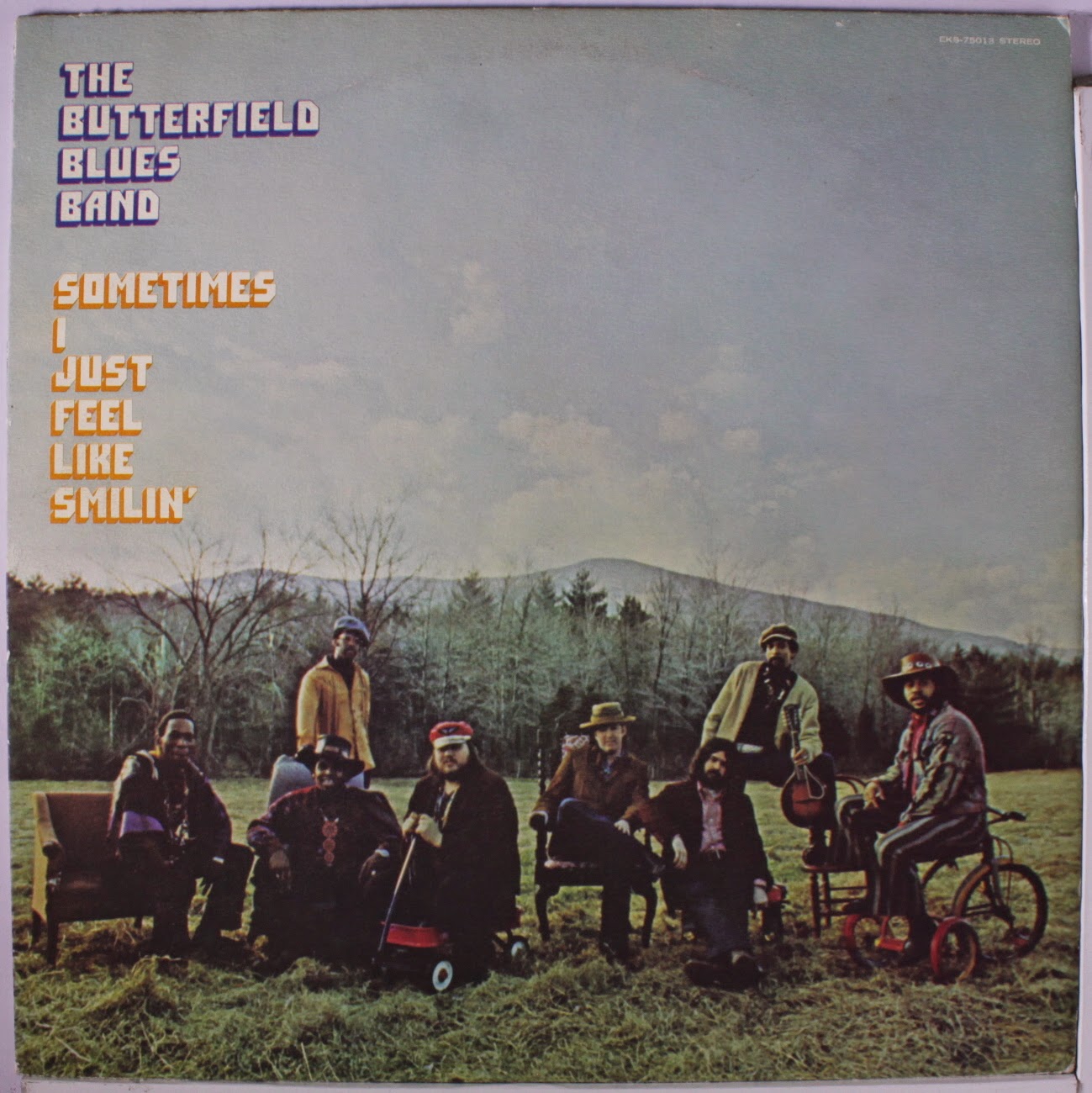
# 45 Butterfield Blues Band Sometimes I Just Feel Like Smilin'

   Twenty years after the great age of sixties Blues-Rock, sociologist Philip Ennis describes the death of the era by pointing to several events which he feels best symbolize the period. He lists: the death of Brian Jones, Jim Morrison, Jimi Hendrix, Janis Joplin, the disbanding of the Beatles..., and then finishes with, By 1969, even the Haight was dead: ........, but in the middle of his list of iconic symbols, he makes a statement which doesn't seem to fit.

     He says, The Paul Butterfield Blues Band was at the end of its creative life. He is implying the false notion that the Butterfield Blues Band has somehow run out of creative ideas at this time. The truth is that by 1971, the Butterfield Blues Band is still a creative force, but about to become another victim of the changing economic expectations of the Rock industry.

   In August of '71, Elektra releases the Butterfield Blues Band's seventh, and final album, Sometimes I Just Feel like Smilin', serving as both a final creative expression from the band as well as a symbolic tombstone for an important personality in the development of a generation's music. In the coming years, historians, music critics, and fans will try to simplify the reasons for the end of the Butterfield band, but as is the norm in history, the complex reality is most often a victim of neglect. One theory can be put to rest though, we only need to listen to the album to conclude that the Butterfield Blues Band is not lacking in creative energy. In addition, they aren't experiencing a massive decrease in audience support either, only a leveling, and they are still making money for Elektra, Albert Grossman, and concert promoters.

   Sometimes I Just Feel Like Smilin' is another one Butterfield's albums which is often overlooked by fans, and underrated by critics. However, it does have weak moments as in the use of Rod Hicks (1000 Ways), and Ralph Wash (Pretty Woman) as lead vocalist. Neither Hicks nor Wash possess the vocal dynamics to be awarded a place fronting a band as powerful as the Butter band. Also, the use of the two bland lead singers presents a frayed focus for listeners, the same error Butterfield makes with In My Own Dream in 1968. (Most bands with a scattered focus do not capture as much success as bands with a single voice, The Band is one example.)

    The other weakness of the album can be found in some of the arrangements. Throughout the latter half of the sixties, Butterfield plays a significant role in the introduction of Rhythm & Blues artists, and their music, to the fresh ears in mainstream Rock, but by '71, his contributions are forgotten. So, when he records a mere duplication of Ray Charles' Drown in My Own Tears or Albert King's Oh Pretty Woman it comes off as trite - lazy behavior for a band of Butterfield's stature.

    However, these are minor criticisms next to the album's strengths. Producer Paul Rothschild and Butterfield have added an powerful group of soulful background singers in Clydie KingMerry ClaytonVenetta Fields, and Oma Drake. Their addition to the band separates the album's music from all of the other horn bands which are springing up by the early seventies. The singers also allow for the addition of Gospel, Soul, and Funk influences into their music. Decades later, the album still sounds like a fresh blend of yeasty Americana music, with a soundscape reminiscent of a Phil Spector's, wall of sound.

    Butterfield shows up as a much stronger songwriter on this album too. He has credits in over half of the nine compositions, all of them well crafted. Two of those compositions Night Child and Song for Lee should be recognized as the first Jazz/Rock instrumentals which feature a harmonica.

    Sometimes I Just Feel Like Smilin' even has the most pop oriented song ever recorded by any of the Butter bands. Butterfield and his wife Kathy, are credited to Blind Leading the Blind, a catchy Gospel flavoured shuffle. Unfortunately, it proves to be no match for hits by other top 70's horn bands: Chicago Transit Authority's new album 111 reaches # 2, Lighthouse's single One Fine Morning peaks at # 2, Blood Sweat and Tears' single Go Down Gamblin' #10, and even newcomers Edgar Winter's White Trash's first album is working its way up to # 70 on the album charts. The lack of promotion from Elektra is part of the reason Sometimes I Just Feel Like Smilin' is struggling to hold on to #124 on the album charts.

    It is easy to point to the lack of mainstream pop hits as the reason for the decline of the Butterfield Blues Band, but during the sixties, and early seventies, it isn't unusual for bands to have very successful careers with no major mainstream hits. In fact, fans of artists associated with the counter culture movement often consider the position as a badge of honor. However, that attitude is changing. By the early '70's Rock is becoming a huge industry feeding off massive outdoor festivals and album sales. Consequently, record labels, promoters, and artist managers are expecting bigger pay offs for their investments.

   So, why does the Butterfield Blues Band end? There is no key breakdown in personnel as happens within the Beatles, or death of the voice of a band as is the case with Morrison or Joplin. There is none of that dynamic taking place in the Butter band. It seems that most plausible scenario is one which begins, and ends with one word, money.

    Around 1970, Butterfield's manager Albert Grossman is spending most of his time away from his New York City management offices, and instead, focusing his energies on building his entertainment empire in Woodstock, New York. Some sources suggest that he makes this retreat because of the death of Janis Joplin, but this seems unlikely as a key reason. He is disappointed by the Blues singer's senseless departure, but he also collects on the 200K life insurance policy he purchases before her death. Grossman seems too calculating to succumb to such intense emotions. Regardless, he does retreat upstate, and consequently his business interests in the city suffer. This will prove to contribute to the end of Butterfield's band, but also push Butterfield's career in new, and more positive directions.

   In addition, Butterfield's label Elektra Records has made a complete transition from recording acoustic folk in the early sixties to electric mainstream pop artists. The change is proving lucrative for them as they now employ some substantial revenue generators: the Doors, Bread, and Badfinger to name a few. These assets are definitely making more money for them than the Butterfield Blues Band. The band has not become a financial liability for them yet, but the label is beginning to neglect their investments in the band.

    So, the end of the Butterfield Blues Band seems to be best described as a product of business the dynamics between Grossman & ElektraButterfield is just an artist caught in the middle. During this period he is about to be faced with decisions he does not want to make. He just wants to carry on creating music, but whether he likes it or not Grossman presents him with this ultimatum:, disband your group, leave Elektra, and come with me or face extinction. Grossman is starting his own label, Bearsville Records, and negotiates a distribution deal with Warner. He wants Butterfield to be one of his first artists, and so secures him a $250,000 deal. (a large sum of money in '71)

   The dilemma for Butterfield is if he stays with a Elektra, he will probably lose Grossman as his manager, and his future with the label is not looking positive anyway. As Nick Gravenites describes the situation, Albert had made Paul a huge record deal with Warner Brothers, which was affiliated with Grossman’s Bearsville label,  He told him, I’ll give the money to you, but I won't give it to (the other band members).  If you take it - just you can keep it.  If you split it with the band, they've got to pay off their debt to me.  Paying their debt consisting of expenses typically covered by management would have wiped out the funds from Butterfield’s deal, ....  Paul was begging pleading with him not to do that, says Gravenites.  In the end, though, Paul took the money. If you are standing on the outside of this decision, the solution may appear simple, but for Butterfield it is about more than just money, there is security, attachment to Grossman, and loyalty to his band members, and family to consider.

    In addition to all of the business issues facing him, Butterfield also has personal considerations too. He has been living in Woodstock for three years now, remarried, has a young son, Lee, a comfortable house with several acres on Highway 212, a couple of horses, two dogs, and many musician friends in the area. (the photos for the album cover are done in his backyard.) Most of his domestic stability is a result of his reputation as a musician, a bandleader, and seven years on the road. There must be times when he feels isolated, relieved, contented, and yet anxious about the potential of being unemployed with no band to call his own. The whole emotionally exhausting experience must leave him caught somewhere between smiling, and wishing for better days.
    Every artist's career conforms to its own trajectory, the commonality is that they all rise from obscurity, peak, and begin a descent back into obscurity. For pop bands the process usually takes about five years, but blues bands, it's only two years. Most of the time it has nothing to do with the creative energy, or the quality of music, but rather situations which are out of their control. The trick is that once an artist reaches their peak, they need to drag out the decline as long as possible. The Rolling Stones have been coasting down for thirty years, and the Beatles even longer. In the case of the Butterfield Blues Band's career, it seems to peak with The Resurrection of Pigboy Crabshaw, and then declines to reach its end with Sometimes I Just Feel Like Smilin'.

    In '72, Elektra will release Golden Butter: The Best of the Paul Butterfield Blues Band. It is testament to the financial impact the band has on Elektra Records; most of the double album is devoted to the first two albums, offers only minor recognition to everything else the Butter Band records, and only whispered lip service to the other contributions he makes to popular music in the 1960s. It peaks at #136 on the album charts.  In addition, U.K. label Red Lightin' releases An Offer You Can't Refuse (see post #3) in 1972.

   The irony of the end of the Butterfield Blues Band is that for the remaining life of Paul Butterfield's career, he will be constantly measured by the what he accomplishes in his original Butterfield Blues Bands. The one relief for him in his the new phase of his career is that he will never have to answer interview questions requesting an explanation of why his music isn't blues. That question must have wiped the smile from his face a few times.

the Butterfield Blues Band : Sometimes I Just Feel Like Smilin'

1) Play On, 2) 1000 Ways, 3) Pretty Woman, 4) Little Piece of Dying, 5) Song For Lee, 6) Trainman, 7) Night Child, 8) Drown In My Own Tears, 9) Blind Leading The Blind.

Paul Butterfield: Vocal, harmonica, (piano on Blind Leading The Blind), Gene Dinwiddie: Tenor & soprano saxophone, flute, tambourine, (vocal on Drowned In My Own Tears), Rod Hicks: Bass, (vocal on 1000 Ways), Ralph Wash: Guitar, (vocal on Pretty Woman), Dennis Whitted: Drums, Bobby Hall:, Conga, bongos, Ted Harris:, Piano on Night Child, and Play On, George Davidson: - Drums on Night Child, and Play On, Trevor Lawrence: - Baritone saxophone, David Sanborn: Alto saxophone, Steve Madaio: Trumpet,  Big Black: Congas.

Background Vocals: Clydie King, Merry Clayton, Venetta Fields, Oma Drake, Paul Butterfield, Rod Hicks, Ralph Wash, Gene Dinwiddie.

Producer: Paul Rothchild, Recording Engineers: Fritz Richmond, Bruce Botnick, Marc Harmon. Re-mixing Engineer: Fritz Richmond. Mixing: Todd Rundgren,   Album Photography: Barry Feinstein.


Friday, April 4, 2014

# 44 Butterfield Blues Band Live at A. & R. Studios on WLPJ

    The success of any artist is a big major business venture. It's one thing to record an album, quite another to get the product promoted, and sold to the public. If you have a motivated label, they will do the manufacturing and distribution, but you also need a capable manager to secure the high profile gigs too. Then there are the producerslocal retailers, and a multitude of other talent involved in the whole process. However, for all artists the most important feature of the whole venture is the live performance. 

     By 1970, live broadcasts of musicians has become a staple of radio, FM and stereo sound isn't new either, but during the '60's all of these technologies are uniting into common features for anyone with a home radio. (It seems similar to the transition of regular analog television into digital high definition broadcasts.) 


    Part of the success of this transition is because of a couple of enterprising young men with a vision to record quality music. In 1958, Jack Arnold and Phil Ramone establish  A. & R. Recording Studios in Manhattan, New York City. (Ramone is an innovator! On Oct. 1st, 1982 the first compact disc is released, and so, on that date he releases a digital version of Billy Joel's 52nd Street to help promote the new Sony compact disc player being released in Japan.)

    During the sixties Ramone develops a reputation as a skilled sound engineer, and producer which attracts a really diverse collection of top recording artists to A. & R. StudiosThe list of people who use the state of the art facility is lengthy, and quite impressive. Everyone from Ray Charles, The Band,and Bob Dylan to Anne Murray, and Frank Sinatra want to reap the commercial benefits of Ramone's talent in the engineering booth.   


   So, as the Rock music trend grows, Ramone and his company team up with WLPJ FM to produce, and broadcast concerts live from A & R Studios.  Artists like the Allman Brothers,(another band inspired by The Paul Butterfield Blues Band), Procol Harum, Elton John, and Jimi Hendrix are some of the first to participate in the live simulcast concerts. Unfortunately, in spite of the popularity of the series, it proves financially unreliable for sponsors, and it's cancelled. 

    However, the Singer Sewing Machine Company rescues the series with an offer to act a the main sponsor. As unorthodox as the marketing strategy sounds today, the sewing machine company actually has a record department in most of their New York stores. In addition, as part of their promotion of the new series, Singer will offer a discount on the albums of the artist being featured that week. The very first band to appear on the new series in December of '70 is the Butterfield Blues Band who are promoting their Live album to Christmas shoppers. As a piece of trivia, all the Singer stores will offer fans the new double album the Butterfield Blues Band Live for $3.97, and all of his previous albums for $ 2.89, quite a deal!!

    Of course, the sound quality of the show is excellent, and the performances rival the ones on Live. Also, listen to George Davidson's replacement on drums, Dennis Whitted. Highlights of the show are Born Under a Bad Sign, and the outstanding harmonica solo on Everything's Gonna Be Alright.  

The Butterfield Blues Band: Live at the A&R Studios on WLPJ in New York City, December 1970.

1) Born Under a Bad Sign, 2) Play On, 3) Driftin’ and Driftin’, 4) The Boxer, 5) Everything’s

Gonna Be Alright, 5) Drown In My Own Tears (Gene Dinwiddie vocals), 6) Country Side, 7) Love March, 8) Back Together Again, 9) So Far, So Good.

Paul Butterfield: Harmonica & Vocals, David Sanborn:  Alto Saxophone, Gene Dinwiddie: Tenor Saxophone, Flute, Vocals, Dennis Whitted: Drums, Steve Madaio: Trumpet, Rod Hicks: Bass, Ralph Wash: Guitar, Trevor Lawerance: Baritone Saxophone


Monday, March 31, 2014

# 43 Live at the Troubadour


    By 1970, the Butterfield Blues Band's album sales have stagnated, and the income from live shows is stalling too. Butterfield doesn't seem to care though, he just wants to play music. However, the situation is causing Elektra, and Albert Grossman some frustration. At this point, they can't seem to figure why their client Paul Butterfield isn't more successful.

    He's good songwriter, but none of his songs seem to capture the imagination of the mainstream market, and in the golden age of singer/songwriters his catalog is comparatively small. As a vocalist, he is a convincing interpreter of Blues, but this skill doesn't seem to transfer over when he performs crossover material.

    Butterfield has what musicians often refer to as  big ears, and he also demonstrates a sharp ear for talent. Similar to all great leaders, he has the ability to surround himself with people more skilled than himself, and can lead them in a direction of his choosing. It is this skill that should earn him the title of one of the great bandleaders of the twentieth century. A combination of his talent, skill, and a moderate yet devoted fan base (mostly male) have already entrenched Butterfield in the history books.  However, in spite of all the things Paul Butterfield has going in his favor; by 1970, the end of his critically acclaimed big band the Butterfield Blues Band is closer than he realizes. It is an unfortunate reality for all performers, you can have all the talent in the world, but if it doesn't transmit into money, your career is at risk.

    There is one talent that Paul Butterfield owns which is unique and sets him apart from most other artists. It's a talent which places him in the company of all of the musicians throughout history, regardless of genre, who are labeled genius. His gift is the emotional energy he generates with a little two dollar, diatonic harmonica. The inexpensive little instrument played by millions of people around the world is heard in almost every genre of music. For example, you will find harmonica solos featured in Classical music, but you will not discover many oboe solos in Rock. This kind of profile should give the instrument a lot respect, but for some reason it doesn't. Throughout the decades most people still seem to think of the harmonica as a just a toy, and consequently not worthy of serious consideration. However, those same people will marvel at the sounds it produces, and often openly lament I wish I could play like that.

    Even if you are not a fan of the harmonica, or know nothing about Butterfield's prowess as a master of the instrument, there is a simple test you can perform. Scan photos or films of Butterfield playing in front of a live audience, and then pay attention to the expressions on the faces of his audience. Most times his audience members seem transfixed by the sounds he is producing.

    It not just his technique (he is a lip purser), or that he plays the harmonica upside down (he is left handed); it's the way he approaches the instrument. He produces a very full, round tone, most often using a heavy vibrato which he then uses to weave in and out of melodies as no other harmonica player does. Anyone can learn his physical technique, but to use it as he does, is a unique gift. The sound Butterfield chisels from his instrument is what causes people to feel , ...we hear Paul Butterfield saying all that one man, could ever say to another man, his only voice the voice of his harmonica. His label Elektra Records, understands this reality, and that is why when you look at the cover photo of his new album Live, the image is of Paul Butterfield, on a stage, drenched in sweat, a man who is expressing his most inner emotions through a little two dollar harmonica - better than any man alive.

    The set list for the 1970 double album, as well as the expanded 2004 Compact Disc of Live is typical of the band's concerts. Most of the performances are excellent, although they do seem tighter next to several bootleg recordings. However, most fans of the Butter Band often point to exceptional highlights on this album. It might be Rod Hick's bass groove on Love Disease or George Davidson's lyrical drum solo on The Boxer, (Detroit's Davidson is recruited by Hick's from the Four Tops), or the blistering speed of Butterfield's solo on Number Nine. (The only other Butterfield contemporary who can play at this speed is Nashville studio musician Charlie McCoy).  However, almost everyone is hypnotized by his harmonica in Everything's Gonna Be Alright. It's just a straight 12 bar blues in G, played over a downtown shuffle, but every note, every phrase he speaks through his harmonica is confident, tasteful, and feels spontaneous.

    Similar to all great musicians, Butterfield's style impresses technicians, and listeners alike. He only uses the five notes of the minor pentatonic scale (six if you include the flat five), and he rarely ventures past the six hole blow, but he plays triplet phrases which deceive the listener to believing he somehow has more notes than are actually available.

    So, why is Butterfield's audience leaving him then? It can't be the addition of 19 year old guitarist from San FranciscoRalph Wash. He isn't as dynamic as Buzzy Feiten or Mike Bloomfield, but he is a favorite of B.B. King, and plays a meaty rhythmic style similar to Elvin Bishop's, only with more finesse.


    It could be the speculation that some critics express after the release of In My Own Dream.  They conclude that Butterfield is playing too much Jazz which young people consider suspect because of its affiliation with the over thirty generation. However, New York's Blood Sweat and Tears, Toronto's Lighthouse, Chicago's Chicago Transit Authority, and New York's Dreams are all doing well in the Jazz Rock idiom, and nobody questions their use of Jazz. Then there is the argument that Butterfield's voice doesn't seem to resonate with mainstream audiences because he is over-matched by his horn section, but on Live, his voice is never over shadowed by any instrument in his band. As producer Todd Rundgren says, This is probably the time when Paul is most challenged by the musicians he's gathered around him, proving his ability to throw down with the best there is, anytime, anyplace. 

    In the Rock press there are even more complementary observations about the album, Rolling Stone reports, This album is perhaps Butterfield’s most rewarding since Born in Chicago. The horns don't  get in the way at all, and Paul’s voice and harp never sounded better. However, none the accolades help to explain shrinking audience.


   The answer to the question might be simple. It could be that Butterfield is no longer in charge of his band, or the music for that matter. After the scathing press he receives for his inexperienced leadership skills while leading the Paul Butterfield Blues Band, he consistently is shying away from the role as the leader. Since In My Own Dream, he is trying to run a more egalitarian workplace, but by the time of Live, he has pretty much handed over the reins of power to Dinwiddie. As David Sanborn says, Gene was the father figure to us all, ten years older, who had been around in Chicago, and knew the bebop vocabulary. He was the most evolved player, harmonically, until Ted came on the scene. But he was the person everyone deferred to. He pulled the charts together and directed the harmonics of the band - Paul didn't read music that well. and by 1970, the band was playing some very involved charts and wonderful arrangements. It could be that Paul Butterfield the egalitarian bandleader doesn't project himself through the music the way he does when he lead his earlier bands, and audiences intuitively understand this reality.

    Regardless of speculation about why or how how Butterfield's audience is continuing to turn away from his music, this new album Live never sounds dated. Compared with all the other horn bands mentioned above, this is a unique collection of tunes still sounds fresh. You can probably put Live on a turntable in any decade, and most people will not identify it as music from the '60's.

   In terms of the harmonica work on the album; even a generation of young innovative players will point to this album as a benchmark to strive toward.  There is no other album that better captures the technical mastery, or visceral energy that lead people to think Paul Butterfield is saying all that one man, could ever say to another man, his only voice the voice of his harmonica.


Butterfield Blues Band: Live,  Recorded at The Troubadour in Los Angeles over March  21st and 22nd 1970 and released December 1970  #72 on the album charts.

1) Everything’s Gonna Be Alright, 2) Love Disease , 3) The Boxer, 4) No Amount Of Lovin’, 5) Driftin’ and Driftin’, 6) Introductions on musicians, 7) Number Nine, 8) I Just Want To Be With You, 9) Born Under a Bad Sign , 10) Get Together Again, 11) So Far, So Good.

In 2004 a second disc of performances on those nights is released:

1) Gene's Tune, 2) Nobody's Fault But Mine, 4) Losing Hand, 5) All In A Day, 6) Feel So Bad, 7) Except You, 8) You've Got to Love Her With a Feelin', 9) Love March.

Paul Butterfield: Vocals, Harmonica, (Piano on Get Together Again), Rod Hicks: Bass, (Vocal on
The Boxer),  Ted Harris: Piano, Ralph Wash: Guitar, Gene Dinwiddie: Tenor and Baritone
Saxophone, Steve Madaio: Trumpet, George Davidson: Drums, Trevor Lawrence: Baritone Saxophone. David Sanborn is still in the band, but does do this tour or this recording.
Produced by Todd Rundgren and Ray Thompson.


Friday, March 28, 2014

#42 Jammin' with Janis Joplin

    Every generation has its talented artists who seem to grow into the role of the tragic hero. Usually, the public watches as these stars descend from their coveted position in the limelight into an off-stage life filled with entertaining melodrama, and too often, ending in an early death.

   The final insult to these stars is when the beneficiaries of their estate promote them as artists deserving of iconic status. This is how many short-lived artists spend the remaining portion of their careers - as a manufactured memory. During the late '60's this tragic hero role is played by Blues Rock legend Janis Joplin. She has a very brief career, but is best remembered for her tragic personal life, and unromantic death rather than her music.

    During childhood Joplin feels disenfranchised from her world, and craves copious quantities of attention. As her mother confides, her daughter's childhood was unhappy and unsatisfied with (receiving a lot of attention). The normal rapport wasn't adequate. This may be what motivates Joplin to gravitate toward the performing arts in her teens, and encourages her to develop her moderate talent into a magnate for public adulation.

     Ironically, when she does attain her attention, the sensation proves too overwhelming, and she seeks refuge in a variety of drugs. Unfortunately, her substance abuse develops into an addiction, and only serves to accelerate her eventual implosion. In fact, during the last couple of years of her career, right up until today, Janis Joplin is not a real person, but rather a one dimensional character created by the entertainment industry.

    The part of her story which involves Paul Butterfield begins when she leaves her native Texas in '63 to live in San Francisco. While there, she attaches herself to the local music scene, and records some rudimentary Blues with the help of Jorma Kaukonen (the future guitarist Jefferson Airplane). However, by '65 her reputation as an out of control abuser of amphetamines (speed), some heroin, alcohol (Southern Comfort), and psychoactive drugs becomes a serious concern within her social circle. Friends can see that her addictions are taking over as her emaciated body is growing weaker each day, so they institute a final act of kindness. They organize a party in an effort to raise money for the young Joplin to buy a one way bus ticket back home.

   For a year she tries, and almost succeeds at reintegrating into mainstream life in Port Arthur, but gives up, and returns to San Francisco in '66. The Paul Butterfield Blues Band, has ignited a national Blues Rock craze a year earlier, and it is especially vibrant in San Francisco. So, this time Joplin's intention is to avoid substance abuse, and concentrate on her singing. She has a raspy (almost abrasive) voice  which she skillfully uses to project the raw sex appeal of world weary, throw your caution to the wind, female Blues Rocker. Local band, Big Brother and the Holding Company recognizes her talent, and ask her to act as their lead singer.     


   Joplin's addition to the band proves to be a wise combination as they gain national attention with her at the front of the group. As their fame expands, they travel to Chicago for a recording session, and manage to secure their first record contract. Then, music industry titan Albert Grossman sees the potential income in Janis Joplin the blues singer, and he signs the band up as his clients. However, Grossman is aware of Joplin's past substance abuse problems, and so, stipulates in the contract that she can not use any intravenous drugs. The agreement is signed, and a long prosperous career should be in front of her.

    However, her break through performance at the Monterey Pop Festival in '67 proves too overwhelming for the young star, and she starts using again. When Grossman finds out, he takes out a $200,000 insurance policy on her life. It sounds cold, but he is a businessman.

    By the spring of '68, the band is now billed as Janis Joplin and Big Brother and the Holding Company, she is a national star, nurturing the public persona of the hard livin', hard drinkin', get while ya can, female blues singer, Rock's answer to Billie Holiday. The relatively new genre of Blues Rock has never had an artist of Joplin's caliber, so she it seems that everything she does is considered ground breaking, especially for women. At the height of her career she is promoted as Janis Joplin: The Queen of Psychedelic Soul.

    As she plays the growing Rock circuit with other rising stars like Jimi Hendrix, Buddy Guy, Richie Havens, Elvin Bishop, and of course Paul Butterfield; she develops her powerful stage charisma, and abilities at working an audience. The first time she shares the stage with Butterfield is at the Wake for Martin Luther Jr. concert in the spring of '68.

    During her very brief career (four years) she shares the stage with Butterfield a number of times. Unfortunately, most of the performances are never recorded, and the ones that are, tend to be have very poor sound quality. For example, she works The Pavilion in New York, Madison Square Garden, Ravina Park in Chicago, the Civic Centre in Baltimore, and the Auditorium Theatre in Chicago, and Butterfield jams with her each night, but none seem to be recorded. 

    The performance routine seems to be that the Butterfield band is Joplin's opening act, and Butterfield jams on a couple of songs during her set. (she never seems to reciprocate.) One of these performances is captured on tape though. Joplin and Big Brother and the Holding Company appear at Ringe Arena in Braintree, MA, in Oct. of 1968 with Butterfield as the opening act. Some audience member manages to capture a couple of songs with the two. (both are terrible quality). However, one of the songs, Raise Your Hand, does feature a dynamic harmonica solo by Butterfield. You can hear the taper yell Yeah!! when he starts, and then the audience's energetic applause at the end of his solo is stunning. There is also Live or Die Blues, and Bo Diddley, both are terrible recordings.

    By far, the best recording of the two is from a March '70, Columbia Studio session in  in L.A. with Grossman's new staff producer,Todd Rundgren. During these sessions, Joplin records three versions of the song One Night Stand with the compete Butterfield Blues Band as a back up band. Apparently, Columbia's intention is to release the song as a single, but the idea is abandoned.

   Of all the times that Joplin and Butterfield performed together live, this studio track is definitely the most complimentary. It is one of those occasions where you realize that, if her personal path had changed, an album of her with the Butterfield Blues Band would become a classic.

    However, several months after those sessions, Joplin is found dead in her motel room on Oct. 4th 1970 of a drug over dose. A generation of 60's Rock fans lose another hero on that day, and Albert Grossman collects $200,000. Decades after her death Janis Joplin has become an icon, especially to female singers who harbor desires to break free.

Rolling Stone ranks her as #28 on its list of 100 Greatest Singers of All Time.


Monday, March 24, 2014

# 41 the Butterfield Blues Band Keep on Movin'

    In the '60's, FM radio is a Godsend for artists like Paul Butterfield. Elektra releases singles from his albums, but none of them earn the title of a hit in the AM market so, FM is the band's best option. They have fewer restrictions on the commercial value of Rock music, making them an ideal promotional medium for many of the underground bands. By the late '60's, a number of FM radio stations are focusing on younger audiences who have an interest in the music which springs out of the the Counter Culture Movement. (It's really the beginning of A.O.R. or Album Oriented Rock)

   The basis of the the Counter Culture philosophy seems to be that most behaviours which oppose the values of the corporate establishment are good, and those that do not, should be labeled a sellout. Unfortunately, by the late '60's the Counter Culture has become mainstream caricature of itself, and its noble philosophy is becoming a shear veil used to market hippie products to middle income kids living in the suburbs. This development benefits record labels, and their artists because in spite of their promoted affiliation with the Counter Culture, they all want AM hit records, and Paul Butterfield is no different. He's is an ambitious artist, employed by a major record label, and managed by one the most important artist managers of his generation. In spite of his public desire to just create and play music, he too wants the fame, and financial rewards that come with owning a hit record

    Back in the '60's, it's common for record labels to hire a producer for their artist. Their position is that they pay the artist an advance for creating the music, in return they agree to manufacture, promote, and distribute that product. This agreement is then complimented with the addition of a good manager, who secures venues for the artist to advertise the product. So, the business end of the music industry has a lot time, and money invested in most artists. Consequently, it is only natural that these investors want to experience as high a return as possible.

    So, for the next Butterfield Blues Band album, Elektra hires the hit maker Jerry Ragovoy as producer. In the 1950's, Ragovoy is an ambitious, A & R man for United Artists who also develops a reputation as talented arranger, producer, and songwriter. He writes Time is On My Side for Irma Thomas, (later a hit for The Rolling Stones), and among many other hits, he also pens Try a Little Harder Erma Franklin and Piece of My Heart for Lorraine Ellison (later hits for Janis Joplin). By the '60's he is successful enough to buy his own recording studio in New York, which he calls The Hit Factory. The premier Rock paper of the day, Rolling Stone describes Ragovoy as: Philadelphia Jerry Ragovoy is one of the top Rhythm and Blues producers, The Staple Singers “Let’s Get Together’ Roy Redmond’s “Good Day Sunshine”.....  He not only produces, also writes arranges, and publishes many of the songs his artists record, and he has just completed building his own 8-track studio (The Hit Factory) I own it all by myself - no partners. He will be the producer of  the latest Butterfield Blues Band album, Keep On Movin'.

   However, there are a couple of problems which Elektra does not anticipate before they hire of Ragovoy. Firstly, Butterfield is a person who feels most comfortable working within a familiar group of people, and he his settled into the Elektra/Grossman family. He views everyone else as a suspicious outsider, and Ragovoy fits that profile. Secondly, Jerry Ragovoy is also a man who needs to control his environment, especially in the studio. So, there is bound to be a confrontation between the two.

    If there will be a compromising figure between Butterfield, and Ragovoy it will be Ted Harris. Initially, Keith Johnson introduces Butterfield to Gil Evans ( a Grossman client) as the band's a musical director, but Evans quits because it interferes with his own work schedule. In his place Ted Harris is recruited by his Detroit colleague Rod Hicks. Harris is a well rounded musician in his own right, and while he is very keen to work with the Butterfield band, he also knows about arranging pop tunes, and has a strong work ethic,  I picked up material in Woodstock, but had to write the charts in Detroit - we’d record all week in New York, and I’d head back to Detroit on the weekends.

    Ragovoy likes Harris' ideas, but he doesn't like Butterfield or his band. Butterfield, and his band see themselves as musical innovators, and frequently engage in free form jam sessions to cull ideas from their music. This apparent lack of structure is simply too unpredictable for Ragovoy. He needs control over his environment, and every aspect of the recording process,  Jac Holtzman at Elektra told me that he wanted a hit from the band, and they came to me because at that time in my life I was suppose to be the ‘king’ of R&B, they wanted that kind of producer..... I had such a dichotomy of emotion about these guys in the studio. I hated them, and I loved them, ....  Personally, they drove me a little nuts I couldn't seem to control them; I’m the kind of producer who wants to have total control in the studio - it’s my game, and my vision. I’m going to sink or swim by my ideas....... At one point I even called Holzman, and told him I’d have to withdraw, but he talked me into staying.  The two to three weeks of recording sessions must have developed into a case of two alpha personalities posturing over a single quarry.


   Then Ragovoy does the worse thing he can do for the project, he doesn't give in, he simply gives up, and that makes the difference in the final product. But at a certain point I gave up on my usual approach, and went through the motions, letting them do what they wanted. I wound up going for a great sound, and I think I got that. But the project was rushed so there wasn't time to select the material or to refine or redo the material we had done...... In the end I wasn't happy with anything we had done - even my things.  (Where Did My Baby Go & Except You)   .....      But I‘m not talking about the charts. Ted Harris did some wonderful arranging, and the horn players played well.  I just wasn't happy with the end product. We did it in two or three weeks, and we should have had eight - the potential was there for a great album.

    In spite of the fact that Butterfield never expresses any regrets over his contribution to the failure of the sessions, years later Ragovoy will feel more philosophical about the project . .......  When I heard Sanborn and Buzz, I recognized they were both monsters.  They were
both natural, great talents; in fact, they were two of the great talents I've heard since I started producing.  And I knew Butterfield wanted to stretch out, I heard a lot of jazz influences from the band. Paul was a great harp player, and I think a good blues singer, but I think he was over-matched by the jazz influence in the band. My feeling was that if he going to move in the jazz format, then the material needed to be  more carefully selected for Paul’s voice so he could get through it naturally. I heard a fight then, and I hear it today when I listen again.

   Ragovoy's insight about Butterfield being over-matched by his own music are very evident in some of the material. For example, on Morning Sunrise his voice sounds strained, as though he either hasn't been able to mount the song properly, or he is out of his element. Butterfield really is an excellent blues singer, but he does not always sound comfortable in the Rhythm and Blues/Jazz format, and next to David Clayton Thomas or Robert Lamn this quality becomes a serious liability.

    In an effort to capitalize on the band's appearance at WoodstockElektra releases Love March as the album's single, but the catchy sing-a-long doesn't earn sustainable traction in the AM market, and is soon forgotten. Love March is such a curious departure from anything the band performs on record or live. In fact, in 1969, there is no blues band that has ever recorded this type of material. (It is probably the only song played by a blues band with the lead singer playing flute to a military march.)  
     When an interviewer asks Butterfield if the song is an attempt at going commercial (selling out)  he says, It wasn't conceived as a pop thing. It was done as a very happy thing. We were just messing around with it, and decided to put some lyrics to it, and Gene Dinwiddie wrote some lyrics. I wasn't really sure myself what the tune was for a long time, but now I really enjoy it. 

    After its release, reviews tend less to be cold to tepid, but the varied reaction seems to be more a result of confusion about the music than its quality. In spite of the rhetoric of the day, people really do like labels, and for the music of the Butterfield Blues Band that chore is a difficult task to undertake. However, there are some bright lights as Rolling Stone reports, This album is with the exception of two out and out early Ray Charles imitations, the farthest thing from the blues that Butterfield has ever done. Which is alright in itself - the problem is that it isn't new-wave jazz, gospel, soul, country or golden oldie material either.  It’s a strident limbo of in-between. As an artist, this is exactly what Butterfield is always grasping for, a strident limbo of in-between. Unfortunately, it is not what most listeners want, and the album only manages a position of # 102 on the album charts. Oddly enough, the band will use many of the songs as part of their regular set list in the coming concerts.

   In the end, nobody gains from the combative atmosphere during the recording of Keep On Movin', Butterfield loses an opportunity to make a solid cross over album with a top pop producer, Ragovoy misses a chance to list yet another commercial success to his resume, and Elektra does not get their hit record from the band. It will be another debit that some Elektra Records accountant will enter under the name Paul Butterfield.

   Sighting artistic differences as his main reason, Feiten leaves the band after the release of  Keep On Movin', as does Freddie Beckmier. Tired of life on the road, Philip Wilson returns to Chicago where he becomes an active member of The Art Ensemble of Chicago, and Keith Johnson leaves to return to studio work in New York. They all depart with opportunities made available because of their time in the Butterfield Blues Band.

Butterfield Blues Band : Keep on Moving,       October 1969  #102 on Billboard album charts

1) Love March, 2) No Amount Of Lovin’,3) Morning Sunrise, 4) Losin’ Hand, 5) Walkin’ By Myself, 6) Except You, 7) Love Disease, 8) Where Did My Baby Go, 9) All In A Day, 10) So Far So Good, 11) Buddy’s Advice, 12) Keep On Movin’.


Paul Butterfield: Vocal, Harmonica, (Flute on Love March), Gene Dinwiddie: Tenor Saxophone, Flute, (Vocal on Love March, Vocal chorus on All In A Day), Philip Wilson: Drums, Percussion, (Vocal on Love March, Vocal chorus on All In A Day), Dave Sanborn:  Alto Saxophone, Keith Johnson: Trumpet, Buzzy Feiten: Guitar, Organ, Piano, (French Horn on Love March), (Vocal on Buddy’s Advice, and All In A Day), Rod Hicks: Bass, Cello, (Vocal on All In A Day), Steve Madaio:, Trumpet, Ted Harris: Piano, Trevor Lawrence: Baritone Saxophone, Fred Beckmeier

Jerry Ragovoy: Piano on Where Did My Baby Go, Fred Beckmier: Bass on My Buddy’s Advice and Where Did My Baby Go.